


When RV owners ask, “Why does my RV AC keep running?” they are usually observing their air conditioning system operating nearly nonstop, without cycling off the way it normally should. An RV AC running constantly means the system is struggling to reach or maintain the target temperature, cannot accurately sense indoor temperature, or is dealing with environmental conditions that push its cooling capacity to the limit.
While some continuous runtime is normal during extreme heat, prolonged, uninterrupted operation often points to airflow issues, maintenance problems, thermostat faults, or an undersized or aging cooling system. Understanding the potential causes allows owners to diagnose the issue more confidently and determine whether repair, maintenance, or supplemental cooling would improve performance.
Shop Furrion Chill® RV Air Conditioners
Why an RV AC Running Constantly Matters
When an AC never cycles off, it undergoes more mechanical stress, consumes more energy, and can shorten the life of components like the compressor, fan motors, and capacitors. In the confined space of an RV, thermal conditions and airflow patterns can change quickly, so any inefficiency becomes noticeable fast.
A rooftop unit that was keeping up with cooling demands last season may suddenly run continuously if filters are blocked, ducts have loosened, or insulation has weakened. This behavior is a clue that something in the cooling chain is no longer performing at its intended capacity.
Common Reasons an RV AC Keeps Running
1. High Outdoor Temperatures or Extreme Humidity
RVs are highly susceptible to ambient conditions because they have thin walls, large windows, and many areas where heat can enter. When temperatures rise above 95-100°F, or when humidity levels climb into the 70-90% range, the cooling load increases dramatically. Heat transfer through the roof, slide-outs, and window glass accelerates, forcing the AC to run continuously just to maintain indoor comfort. In these conditions, even a properly functioning unit may run nearly 100% of the time.
High humidity adds another layer of complexity. Before the AC can cool the air, it has to remove moisture from it. Dehumidification consumes a large portion of an AC’s capacity, especially in tightly sealed RVs where moisture from cooking, showering, or outdoor air remains inside.
How to verify:
Monitor the indoor air temperature relative to the thermostat setpoint. If the AC maintains the correct temperature but never cycles off on hot or humid days, the long runtime is environmental rather than a mechanical fault.
2. Dirty Air Filters Restricting Airflow
Airflow is crucial for cooling performance. Even slight reductions in airflow over the evaporator coil can lower its efficiency, making the AC run longer to produce the same cooling output. RV filters tend to collect dust quickly due to constant door openings, campground dust, cooking particulates, and restricted ventilation pathways.
When filters become dirty, airflow drops, coil temperatures fall, and condensation increases. In severe cases, the evaporator coil can begin to freeze — something that significantly reduces cooling capacity and forces the system to run continuously without reaching the setpoint.
How to verify:
Remove the filters and check for visible dust, pet hair, grease, or discoloration. If you hold the filter up to a light source and cannot see light clearly through it, it needs cleaning or replacement. Restoring airflow can have an immediate impact on runtime.
3. Blocked, Disconnected, or Leaking Ductwork
Many RVs use ducted AC systems with flexible, lightweight ducts routed through the roof or ceiling. These ducts can become kinked, collapse in tight curves, or separate from their connectors over time. Even minor duct leakage sends cooled air into the ceiling cavity instead of the living space, forcing the AC to run longer to compensate.
Uneven airflow is one of the first clues that something is wrong. If certain vents blow significantly weaker than others, or if air volume seems to decrease when slide-outs are extended, the duct run may be partially obstructed.
How to verify:
Walk through the RV and check airflow at each vent. Strong, balanced airflow suggests ductwork is intact. Weak or silent vents may indicate blockages or leaks. Some owners remove vent covers to inspect duct connection points for gaps or crushed sections.
4. Low Refrigerant or Undetected Leaks
RV rooftop AC units are sealed systems designed to operate without refrigerant top-offs. However, vibration, age, and corrosion can cause small leaks that reduce cooling capacity. When refrigerant levels drop, the AC cannot absorb enough heat, so it runs continuously while delivering weaker cooling output.
Signs of refrigerant loss include:
- Air that feels cool but not cold
- Increased humidity indoors
- Frost or ice buildup on the evaporator coil
- Water dripping inside the RV
- Gradual decline in cooling performance over multiple trips
A unit with low refrigerant will almost always run constantly, because it can no longer reach the thermostat’s target temperature.
How to verify:
Refrigerant issues cannot be confirmed visually. A qualified technician must measure system pressures and inspect for leaks. If other airflow-related causes have been ruled out, refrigerant testing is a logical next step.
5. Faulty Thermostat or Thermistor
The thermostat or thermistor (temperature sensor) plays a critical role in AC cycling. If it reads the temperature incorrectly, the AC may believe the air is warmer than it actually is, so it will keep running indefinitely. Sensors can drift out of calibration, become loose from their mounting points, or warm up due to nearby heat sources such as TV electronics or kitchen appliances.
How to verify:
Use a separate thermometer placed in the RV living area. Compare the two readings after the AC has run for at least 20 minutes. A discrepancy of more than 3-4°F suggests a thermostat or sensor issue.
6. Poor RV Insulation or Heat Infiltration
RVs vary widely in insulation quality. Single-pane windows, uninsulated slideouts, large skylights, and thin doors allow heat to enter rapidly. Dark exterior surfaces or campsites with full sun exposure compound the problem. In these situations, the AC may be working exactly as intended but is unable to offset the incoming heat fast enough to cycle off.
Interior heat sources can also play a role. Brewing coffee, running the oven, drying clothes, or even the body heat of several occupants raises indoor temperatures. When the heat load surpasses the AC’s cooling capacity, it simply runs continuously.
How to verify:
Touch interior surfaces during peak sun exposure. If walls, windows, or roof panels feel warm, heat infiltration is likely the root cause. Monitoring indoor temperature fluctuations throughout the day can also reveal how insulation affects cooling performance.
7. Undersized or Aging AC Equipment
Rooftop AC units have a finite lifespan, typically 8–10 years under regular use. As compressors and fan motors age, their efficiency decreases, even if they still run. Wear and tear can reduce cooling capacity gradually enough that owners do not notice until the unit begins running constantly.
Additionally, some RVs leave the factory with just enough cooling to maintain comfort under average conditions. Extended travel in southern climates, frequent boondocking, or camping during heat waves can overwhelm an undersized system. In these cases, no amount of cleaning or troubleshooting will resolve the problem; the cooling demands simply exceed what the unit can deliver.
How to verify:
If the AC is approaching a decade of service or if your RV layout has expanded sections like multiple slide-outs, evaluate whether your rooftop unit is technically capable of cooling the full interior space. If the AC struggles even on moderately warm days, age or insufficient capacity may be the issue.
How to Determine the Exact Cause: A Clear Diagnostic Approach
Because several issues can cause an RV AC to run continuously, owners often benefit from a structured evaluation. This process helps isolate the cause without immediately jumping to mechanical repairs.
-
Measure indoor temperature and compare it to the thermostat.
If the AC reaches the setpoint but does not cycle off, the thermostat or sensor is the likely culprit. -
Inspect and clean the air filters.
Even slightly clogged filters can dramatically reduce cooling performance. -
Check airflow at each vent.
Weak airflow helps identify duct obstructions or leaks. -
Inspect coils through the return-air opening.
Ice buildup indicates airflow or refrigerant issues. -
Check for heat infiltration.
Monitor wall and window temperatures during peak sun hours. -
Evaluate environmental conditions.
High humidity and extreme heat often justify longer runtimes. -
Consider the age and capacity of the unit.
Older or undersized systems simply cannot keep up.
Using this checklist helps narrow the diagnosis before pursuing professional service.
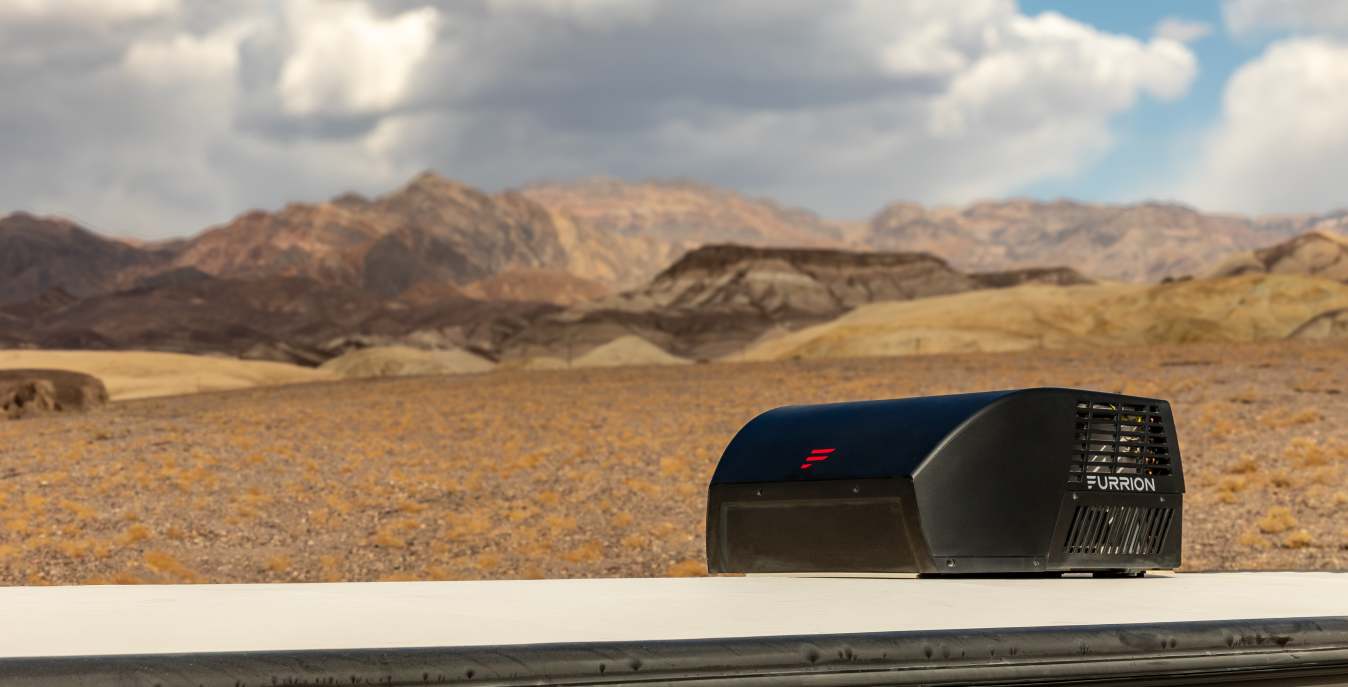
How the Furrion Chill® Cube Helps RV Owners Reduce AC Runtime
The Furrion Chill Cube reduces AC runtime by cooling faster, maintaining steadier temperatures, and operating efficiently at variable speeds instead of cycling on and off at full power.
For many RV owners, long AC runtime is a symptom of a bigger issue: the system can’t keep up. Traditional fixed-speed rooftop air conditioners run at full capacity, shut off, then restart repeatedly. That constant cycling increases total runtime, wastes power, and still struggles to maintain consistent comfort, especially in high heat.
Furrion Chill Cube addresses this problem at the source with variable-speed compressor technology.
1. Faster Cooldown Means Shorter High-Output Operation
Chill Cube delivers 18,000 BTUs of cooling power, capable of producing over one ton of cooling even in temperatures exceeding 105°F. That higher capacity allows the system to bring interior temperatures down more quickly during peak heat.
Instead of running for extended periods trying to catch up, Chill Cube reaches the target temperature faster, then transitions into a lower-speed maintenance mode. This reduces the amount of time the system needs to operate at maximum output.
2. Variable-Speed Operation Prevents Energy-Wasting Cycling
Most RV air conditioners operate at a single speed. They turn on at full blast, shut off once the thermostat is satisfied, then restart when the temperature rises again. This repeated start-and-stop pattern increases overall runtime and amperage spikes.
Chill Cube’s variable-speed compressor continuously adjusts based on cooling demand. Rather than shutting off completely, it slows down to maintain temperature. That means:
- Fewer hard restarts
- Less time spent at maximum amperage draw
- More consistent interior comfort
By avoiding abrupt cycling, the system uses power more strategically and runs only as much as needed.
3. Continuous Low-Speed Operation Improves Dehumidification
Humidity often makes an RV feel warmer than the actual temperature. Standard ACs that cycle off too quickly don’t run long enough to remove sufficient moisture from the air.
Chill Cube’s ability to operate continuously at lower speeds improves dehumidification. Drier air feels cooler, which reduces the need to lower the thermostat further. When the interior feels comfortable at a stable setting, the AC doesn’t have to work as aggressively or as long.
4. Lower Amperage Draw Supports Efficient Power Use
Because Chill Cube ramps up gradually instead of spiking amperage at startup, it avoids the excessive draw that can trip breakers or strain generators. This efficient power management means the system can run more predictably on:
- 2000W generators
- Inverters
- Limited shore power
When power delivery is stable, the system avoids unnecessary shutdowns and restarts that extend total runtime.
5. Battery Saver Modes Optimize Energy Consumption
For off-grid RVers, runtime isn’t just about comfort; it’s about conserving battery capacity. Chill Cube includes battery saver modes that economize power consumption while maintaining interior comfort. By intelligently managing compressor speed and output, the system reduces unnecessary high-load operation.
FAQs About Constantly-Running RV ACs
1. Why does my RV AC keep running even when the RV feels cool?
A thermostat or temperature sensor may be misreading the indoor temperature, causing the compressor to continue running even after reaching the setpoint.
2. Is it normal for an RV AC to run constantly in very hot weather?
Yes, when outdoor temperatures exceed 95-100°F, or humidity is high, most RV rooftop units will run continuously to maintain indoor comfort.
3. Can a dirty filter cause continuous AC operation?
Absolutely, restricted airflow reduces efficiency, increases coil temperature differences, and prevents the system from cycling off properly.
4. How do I know if my AC is low on refrigerant?
Look for symptoms such as reduced cooling, humidity increase, ice on the evaporator coil, or a history of gradual performance decline. A technician must verify refrigerant levels.
5. Can poor insulation cause my AC to run nonstop?
Yes, heat entering through windows, slideouts, and roof panels increases cooling demand, causing the AC to operate continuously.
6. What if the AC runs constantly but never cools the RV evenly?
Uneven temperatures point to duct blockages, disconnected ductwork, or a unit that is not sized appropriately for the RV layout.
7. Does adding a supplemental cooling unit help reduce runtime?
Yes, a compact solution like the Furrion Chill Cube can lower the overall heat load and help the rooftop AC cycle normally.

How to Deal with a Loud RV Air Conditioner
RV AC Upgrade: Signs It’s Time to Replace Your Air Conditioner