


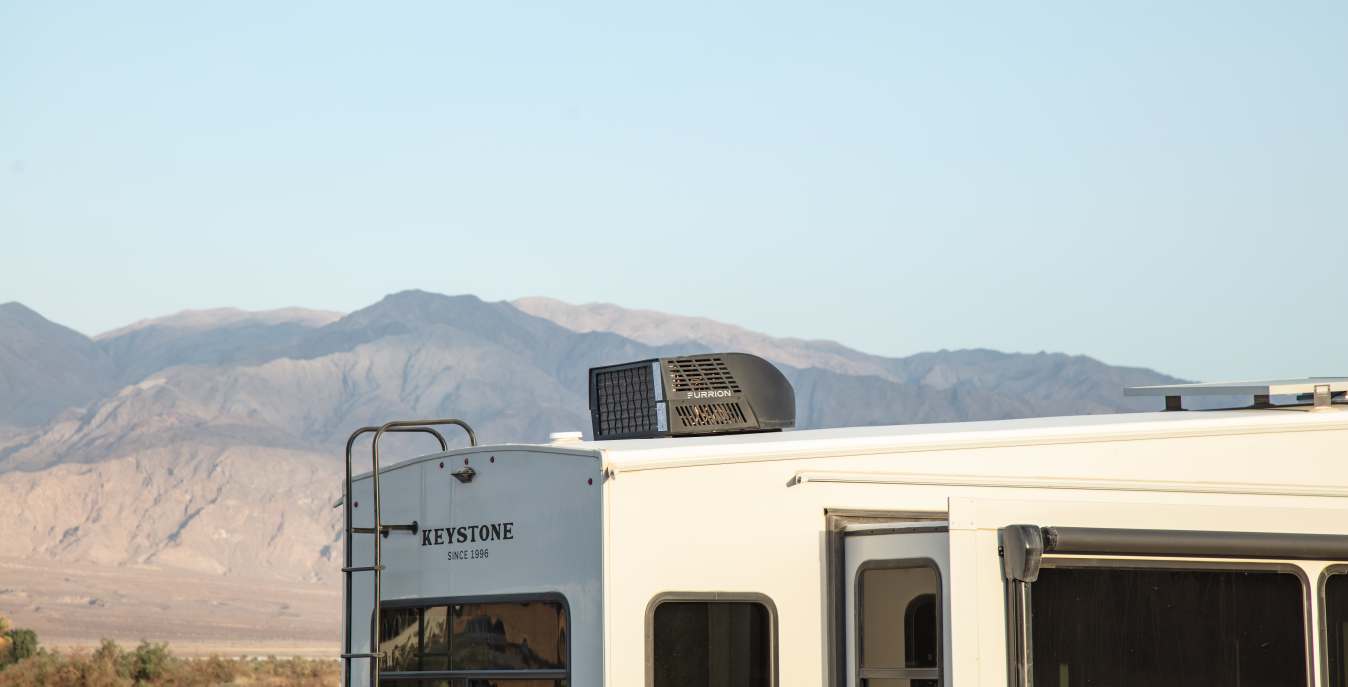
Can you run your RV AC on battery power? In simple terms, yes, but with major limitations. Running an RV air conditioner from batteries requires a large battery bank, a high‑capacity inverter, and enough solar or charging capability to replace the power consumed. Most standard RV AC units draw far more power than typical off‑grid electrical systems can sustain for long. That’s why boondockers often look for lower‑draw cooling options that fit the realities of living off-grid.
This article breaks down what it takes to run RV air conditioning on batteries, the limitations to consider, and how low‑power designs like the Furrion Chill® Cube change the equation for off-grid travelers.
What does it take to run an RV AC on battery power?
Running any air conditioner from batteries comes down to three components: stored energy, inverter capability, and the AC unit’s power draw. Understanding how these interact helps you evaluate whether your electrical system can realistically support cooling while off-grid.
Battery capacity:
Most 13,500 to 15,000 BTU rooftop AC units consume 1,200 to 1,800 watts while running and much more during compressor startup. A typical 100 Ah 12V lithium battery holds roughly 1,200 watt-hours (usable). At full AC load, a single battery could be depleted in under an hour. Sustained AC operation generally requires multiple lithium batteries wired in parallel.
Inverter requirements:
To convert DC battery power into the AC power the air conditioner needs, most setups require at least a 3,000W pure sine wave inverter to handle startup surges. Lower-rated inverters typically overload when the compressor kicks on.
Charging and replenishment:
Even with a large battery bank, boondockers must replace what they use. A typical rooftop AC unit can easily draw more power per hour than most solar arrays can produce. This makes sustained cooling difficult unless you have robust solar, generator support, or a hybrid system.
How long can an RV AC run on batteries?
Most boondockers with standard RV rooftop AC systems can only run them from batteries for short durations — often 30 to 90 minutes — depending on battery bank size and conditions.
This runtime is limited because:
- Standard RV AC units have high compressor loads.
- Battery banks deplete quickly under continuous, heavy draw.
- Off-grid charging sources rarely keep up with AC consumption.
- Inverter and wiring losses reduce usable energy.
While it’s technically possible to extend runtime with large lithium banks and oversized solar, the cost and weight often exceed what most off-grid travelers want to invest.
What are the limitations of running RV AC on battery power?
Even with the right electrical setup, several practical limitations remain:
High power consumption
Traditional rooftop AC units are some of the largest electrical loads in an RV. They demand more energy than most off-grid systems can support for long without constant generator input.
Battery degradation
Deep, frequent discharges shorten battery lifespan, even with lithium chemistry.
Inconsistent performance
Temperature swings, shading, and solar variability complicate reliable cooling.
System complexity
Large inverters, additional wiring, heavier cabling, and expanded safety considerations increase system complexity.
Cost and space requirements
Expanding to multiple high-capacity lithium batteries and a larger solar array adds weight, expense, and storage challenges — significant tradeoffs for boondockers trying to stay lightweight and flexible.
Why low‑power AC units are changing off‑grid cooling options
As more RVers spend significant time boondocking, demand has grown for cooling solutions designed specifically for limited electrical systems. Low-draw air conditioners or modular cooling systems reduce startup loads, operate more efficiently, and match the realities of battery-based power.
Instead of retrofitting an off-grid system around a high-power rooftop unit, travelers can choose equipment designed with boondocking in mind.
How the Chill Cube addresses boondocking cooling challenges
After understanding the challenges above, many boondockers look for alternatives to traditional rooftop ACs. This is where Furrion’s Chill Cube provides a different path.
The Chill Cube is engineered for lower power consumption compared to conventional RV air conditioners. While technical specifications vary by configuration, the design prioritizes:
- Lower continuous power draw.
- More efficient operation on limited electrical systems.
- Compatibility with off-grid setups where battery resources matter.
- Reduced inverter strain due to lower startup loads.
- A modular form factor that allows flexible installation and targeted cooling.
By consuming significantly less power than traditional rooftop AC units, the Chill Cube helps extend battery runtime and reduces dependence on generators. For boondockers who need cooling without excessive electrical demands, it provides a practical alternative built around energy efficiency.
Is battery-powered RV AC realistic for boondockers?
Yes, but expectations matter. Standard RV AC units are not optimized for off-grid energy profiles. Running them from batteries is possible in the short term, but rarely sustainable for long.
For boondockers who want cooling without huge electrical upgrades, choosing a low‑power AC option like the Chill Cube helps align cooling capability with real-world off-grid energy budgets.
FAQs About Running Your RV AC on Battery Power
1. Can you run an RV AC on battery power?
Yes, but standard RV AC units draw large amounts of energy, so runtime is usually limited without a large battery bank and inverter.
2. How many batteries are needed to run an RV AC?
Most rooftop AC units require multiple lithium batteries to power them for even one hour. Power-hungry systems may need three to six 100 Ah batteries.
3. Do solar panels provide enough power for RV air conditioning?
Most solar arrays cannot fully support continuous rooftop AC operation. Solar can extend runtime, but usually cannot replace all the energy consumed.
4. Is a soft-start device enough to run AC on batteries?
Soft-start devices help reduce startup spikes but do not reduce the AC’s overall power consumption. They are helpful but not a complete solution.
5. Can a low-power air conditioner run longer on batteries?
Yes, lower power draw results in longer runtimes, less battery strain, and smaller inverter requirements.
6. Do generators work better than batteries for AC?
Generators provide more sustained power but introduce noise and fuel considerations. Many boondockers prefer battery-first solutions.
7. Is the Chill Cube suitable for off-grid cooling?
The Chill Cube is designed with lower power consumption than traditional rooftop AC units, making it more compatible with battery-based systems.
RV AC Upgrade: Signs It’s Time to Replace Your Air Conditioner
What to Consider When Running Your RV AC on Solar Power